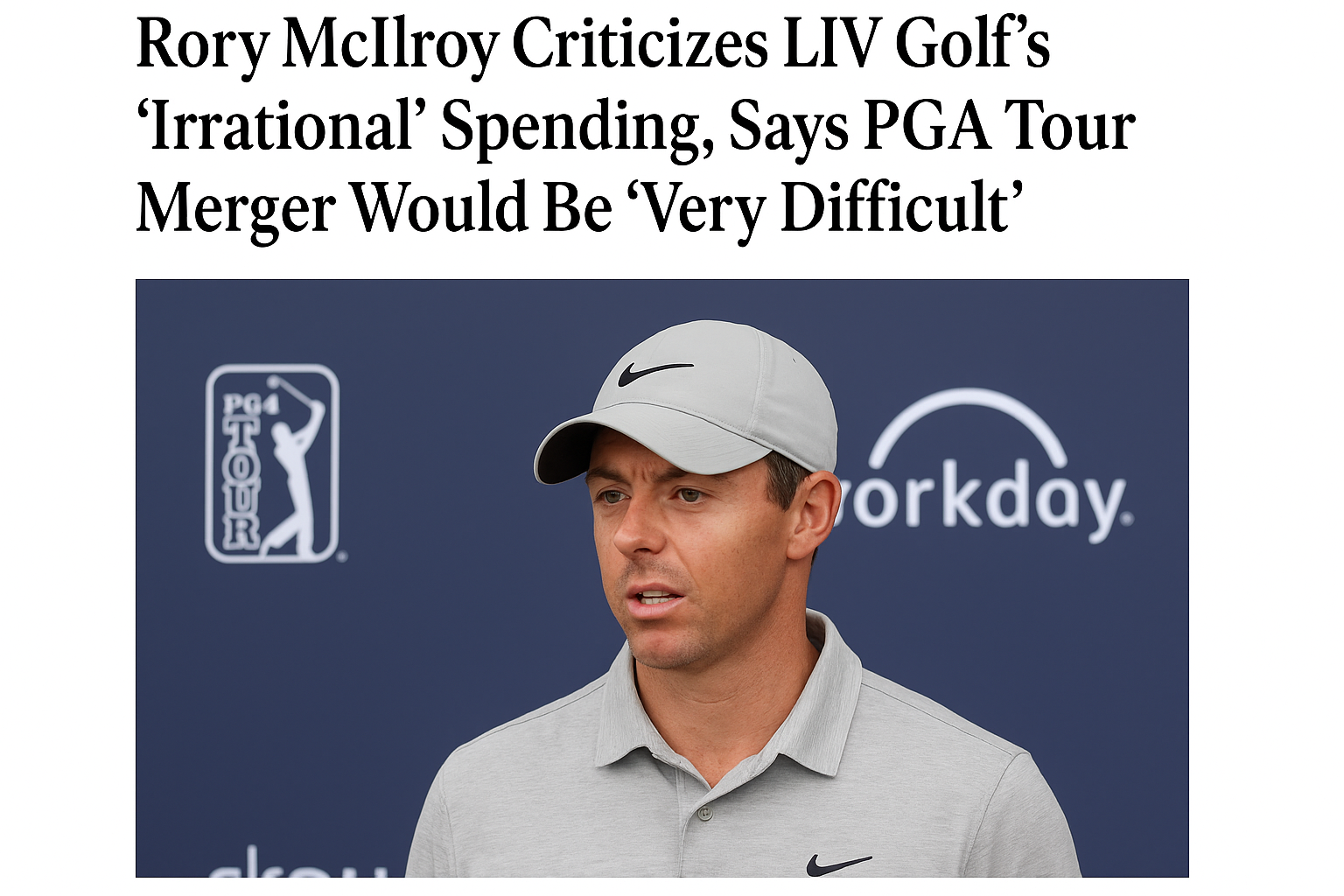
Introduction: A Sport Searching for Stability
Golf has spent the past several years navigating one of the most turbulent periods in its modern history. The emergence of LIV Golf in 2021 fractured the professional landscape, pulled top players in competing directions, and ignited a global debate about money, tradition, and the future of the sport.
Now, even after months of speculation about a possible reunification, one of golf’s most influential voices is openly expressing doubt. Rory McIlroy, fresh off his historic 2025 Masters victory, has made it clear he sees more obstacles than opportunities when it comes to a merger between the PGA Tour and LIV Golf. His recent comments at CNBC’s CEO Council Forum offered a blunt assessment — one rooted in experience, realism, and perhaps a touch of weariness after years at the center of the sport’s civil war.
As he put it, unifying the tours sounds great in theory. In practice? It’s “very difficult.”
In a sport known for calm tones and polite decorum, McIlroy’s latest remarks hit with unusual force. And they raise a pressing question: is golf anywhere close to healing its divide?
McIlroy’s Candid Appraisal of a Fractured Sport
A Voice That Carries Real Weight
McIlroy has never been shy about sharing his perspective, especially when the integrity or future of the sport feels at stake. Over the past four years, he has found himself simultaneously competing at the highest level and serving, voluntarily or not, as one of golf’s most visible spokesmen.
Speaking to a room filled with global business leaders, he addressed the potential merger without hesitation. He said the idea of bringing the PGA Tour and LIV Golf back together is admirable but wildly complicated — and complicated in a way that feels less like a puzzle and more like a tangled mess of competing interests, legal obstacles, and financial realities.
His tone suggested both skepticism and fatigue. “You see some of these other sports that have been fractured for so long,” he said, referencing boxing and American motor racing. Those examples, he implied, are cautionary tales. Once a sport splits, reunification becomes a marathon full of missteps, missed chances, and unresolved tension.
Golf, he believes, risks the same fate.
The Difficult Path Toward Unification
Lessons From Other Divided Sports
McIlroy’s comparison to boxing wasn’t accidental. In that sport, rival promotions have spent decades struggling to align, often preventing fans from seeing the biggest fights. His analogy to IndyCar and NASCAR carried the same message: fragmentation dilutes the product, confuses viewers, and creates two versions of the same entertainment that rarely meet in the middle.
He argued that, for the good of the sport, unity is the ideal. Fans want clarity. Players want a single ecosystem. Sponsors want a stable marketplace.
But ideals, in this case, collide with reality.
“I just think with what’s happened over the last few years,” McIlroy said, “it’s just going to be very difficult to be able to do that.”
Four years of legal battles, public feuds, and record-breaking contracts have reshaped the power dynamic between the tours. And those changes are not easily unwound.
LIV Golf’s Spending: “Irrational” and Unrelenting
An Economic Strategy That Defies Convention
McIlroy saved his sharpest criticism for LIV Golf’s financial model. He described the Saudi-backed league’s approach as “irrational,” not as an insult but as an economic reality check. The organization’s method of courting talent — by offering guaranteed contracts, many exceeding $100 million USD — has rewritten the cost structure of professional golf.
He noted that billions have already been spent without producing any measurable return on investment. “It’s been four or five years and there hasn’t been a return yet,” he said. And the spending won’t end soon. According to McIlroy, maintaining LIV Golf’s current roster will require “another five or six billion” over the next cycle alone.
The problem, as he sees it, is that players whose contracts expire will expect equal or higher compensation. That means the financial treadmill continues. “A lot of these guys’ contracts are up,” he added. “They’re going to ask for the same number or an even bigger number.”
Which raises an important and uncomfortable question: how does a merger work when one side operates as if the budget is limitless and the other must balance books?
A Sport Pulled Between Tradition and Transformation
The Traditional Model vs. the Disruptor
McIlroy has long positioned himself as a supporter of the established structure of men’s professional golf. The traditional model rewards performance, long-term consistency, and tournament prestige. LIV Golf flipped that paradigm by guaranteeing money upfront — a strategy that lured several major champions and international stars.
In McIlroy’s view, this financial free-for-all makes negotiations nearly impossible. If one side operates according to market logic and the other works outside those constraints, how do you find a middle ground?
His frustration is not rooted in resistance to innovation. Rather, it stems from the belief that the sport needs a coherent pathway — not two parallel systems sprinting further apart each season.
A Fictional Moment That Speaks to the Real Crisis
A Behind-the-Scenes Glimpse
To capture the emotional undercurrent of the debate, imagine a fictional scene that mirrors the real tension. Picture McIlroy walking off a practice range at the DP World Tour Championship, approached quietly by a fellow pro who once considered joining LIV.
“I thought the money would fix everything,” the player confides. “Turns out, it only fixed my bank balance.”
McIlroy nods, half empathetic, half exasperated. “The game has to matter,” he replies. “Otherwise, what are we even doing?”
While fictional, the sentiment reflects the very real conversations happening throughout the sport.
The 2025 Context: A Season of Contradictions
Triumph and Turbulence
McIlroy’s comments come in a year where he reached a career milestone by winning the 2025 Masters, completing one of golf’s most coveted achievements. Yet even at the height of personal success, the bigger picture remained clouded by uncertainty.
Golf is experiencing record viewership in some markets, declining engagement in others, and a constant tug-of-war among sponsors trying to navigate divided loyalties. In that environment, McIlroy’s call for caution feels less like pessimism and more like hard-earned realism.
The Road Ahead: Is a Merger Even Feasible?
Major Questions That Remain Unanswered
McIlroy’s remarks highlight several unresolved challenges:
-
How do you merge two financial models that operate on opposite principles?
-
What happens to guaranteed LIV contracts in a unified system?
-
How do players reconcile years of public hostility and legal disputes?
-
Who governs the merged tour — and who funds it?
Until those questions find credible answers, negotiations may remain theoretical at best.
Conclusion: A Sport Still Searching for Direction
Rory McIlroy’s commentary is larger than a headline — it’s a snapshot of a sport caught between ambition and uncertainty. His criticism of LIV Golf’s spending is not personal; it’s a reflection of economic realities he believes are unsustainable.
His doubts about a merger aren’t rooted in reluctance but in pragmatism. Too much has happened, and too much money has changed hands, for the tours to snap back together cleanly.
Golf may eventually find a path to unification, but if McIlroy is right, the journey will be far more complicated — and far less predictable — than many fans hope.
For now, the divide remains. And the sport, much like its players on a windy day at Augusta, is trying to figure out which direction the next shot should go.
Leave a Reply