Introduction
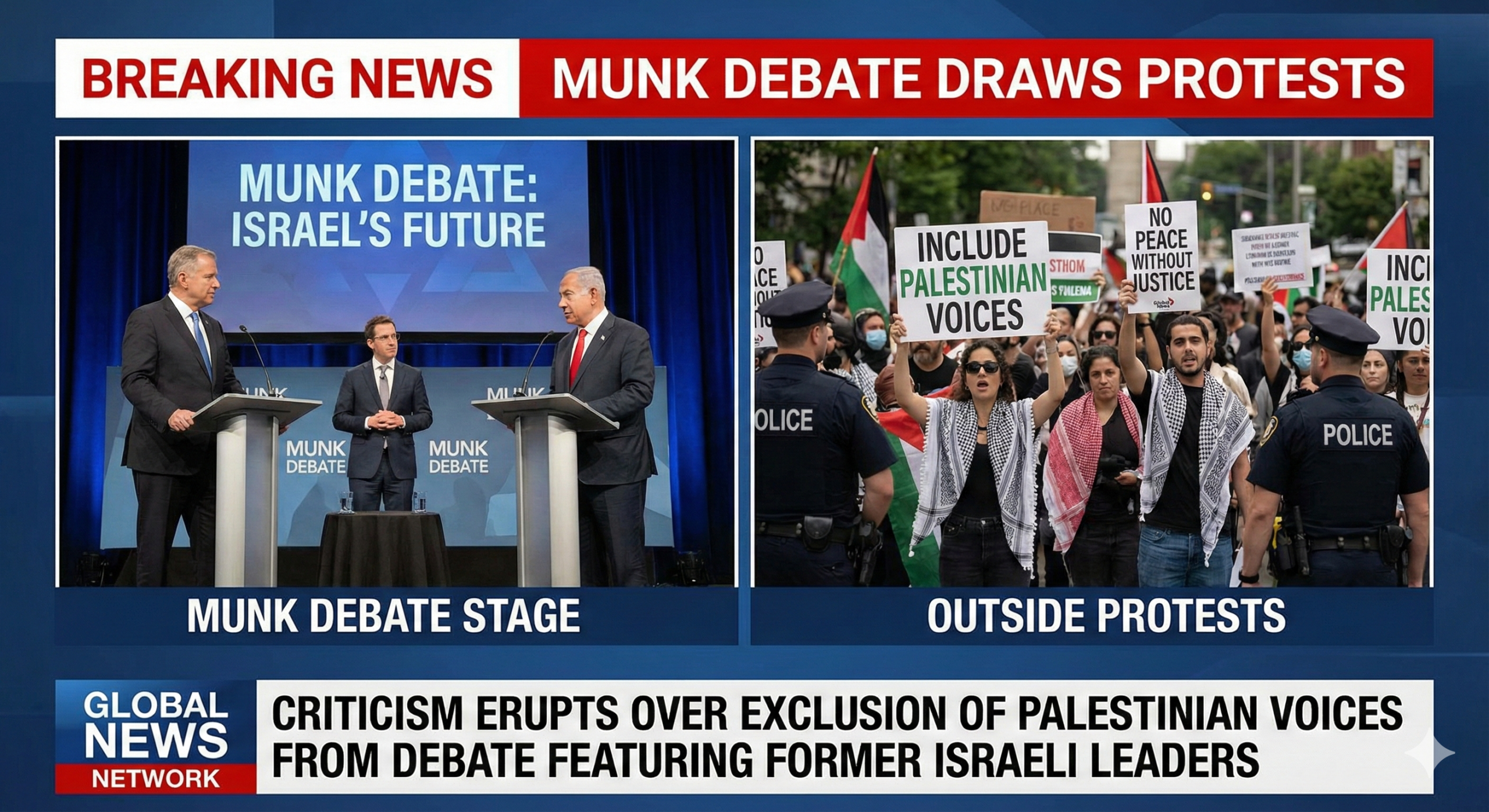
A major debate convened by the Munk Debates — featuring prominent former Israeli officials — was met with vocal protests, impassioned chants, and accusations of war crimes. Held under the banner of “Be it Resolved, it is in Israel’s national interest to support a two-state solution,” the event ignited deep controversy for notably excluding Palestinian perspectives. Demonstrators rallied under Palestinian flags, challenging the legitimacy of the debate and demanding representation of those most directly impacted. Police intervened and dispersed the gathering, but not before the protestors underscored their objections in stark terms.
Protests Erupt Over Closed Door Format
Demonstrators Speak Out
Before the debate commenced, a crowd of protesters assembled, hoisting signs and Palestinian flags. Their unified message was clear: the debate should not proceed without Palestinian representation. One protester, Trevor Miller, described the gathering as “unacceptable,” condemning the event’s format. “We are here to speak out for the people of Palestine, everyone who suffers under imperialism,” Miller declared, underscoring the conviction driving the demonstration. The protest was passionate but ultimately short‑lived, as law enforcement moved in to break up the crowd.
Accusations of War Crimes and Systemic Silencing
Many protesters framed the debate as symbolic of broader systemic issues: the marginalization of Palestinian voices, and the perceived normalization of policies they consider complicit in what they described as war crimes. The chants and placards reflected a growing frustration — not just with the debate’s content, but with the process itself, which denied agency to those most impacted. For critics, the event exemplified a troubling tendency to foreground Israeli political elites while sidelining Palestinians altogether.
Debate Format: Two‑State Solution Under the Microscope
The Munk Debate was structured around one central motion: “Be it Resolved, it is in Israel’s national interest to support a two-state solution.” On one side of the debate were former Israeli officials advocating a prompt adoption of the two‑state framework. On the other side, speakers opposed the resolution, arguing against its political feasibility or wisdom under current circumstances.
Proponents of the Two‑State Solution
Among those arguing in favour were two veteran Israeli statespersons:
-
Ehud Olmert, former Prime Minister, former Finance Minister, and ex‑Mayor of Jerusalem, whose experience spans decades of Israeli politics and diplomacy.
-
Tzipi Livni, who previously served as Israel’s Justice Minister and Foreign Minister, and has long been engaged in efforts toward peace negotiations and two‑state frameworks.
Both offered a clear rationale for supporting rapid movement toward a Palestinian-Israeli two‑state agreement. Citing demographic realities, international pressures, and long‑term security concerns, they argued that a two‑state solution remains the most viable path forward to preserving Israel’s character as a democratic and Jewish state — while addressing Palestinian aspirations for self-determination. They emphasized urgency: without meaningful negotiations and compromises, Israel risks further isolation, internal unrest, and existential long-term perils.
Opposing Voices: Caution or Conscience?
Challenging the motion were:
-
Michael Oren, former Israeli ambassador to the United States and ex‑Deputy Minister during former Prime Minister Benjamin Netanyahu’s second term.
-
Ayelet Shaked, Israel’s one‑time Justice Minister and Interior Minister, known for her staunch national‑security stance and advocacy for a unified Israel.
Their opposition was rooted in concerns over security, territorial integrity, and pragmatic realism. They argued that the current conditions — ongoing violence, mutual mistrust, and political fragmentation within Palestinian leadership — rendered a two‑state agreement unworkable for now. According to them, supporting the motion prematurely could jeopardize Israel’s national security, weaken its strategic position, and risk creating a hostile neighbor state. They urged caution: better to preserve control and security than rush into an uncertain and potentially dangerous agreement.
The Controversy Over Excluding Palestinian Voices
Organizers’ Defense and Backlash
In response to mounting criticism, organizers of the Munk Debate defended their decision not to include Palestinian voices. They argued that the format — a debate between two viewpoints on the motion — was designed to highlight conflicting visions within Israeli political leadership, rather than present a comprehensive regional dialogue. In their view, the event was not a negotiation or mediated peace process, but an internal deliberation over Israel’s interests. As such, they claimed that it was appropriate to limit the discussion to Israeli perspectives.
Yet this explanation did little to appease critics. Opponents charged that by excluding Palestinians altogether, the debate effectively silenced those most affected by its outcome. To many, this was not an abstract political discussion but a conversation with real, far‑reaching consequences for millions of Palestinians whose lives, rights, and futures hang in the balance. Critics argued the format ignored basic principles of fairness, representation, and legitimacy — especially in a debate about Palestinian statehood and sovereignty.
The Moral and Political Implications
The uproar surrounding the debate went beyond partisan disagreement. For protestors and supporters of Palestinian rights, the issue was not simply about which Israeli perspective prevailed — but about who gets a seat in conversations that shape policy, treaties, and human lives. By allowing former Israeli officials to debate the fate of Palestinian homeland without any Palestinian voice present, organizers risked appearing hypocritical at best, callous at worst.
Such events — when they proceed without inclusive representation — can feed into broader narratives of marginalization, inequality, and systemic denial of Palestinian agency. In the eyes of many observers, the exclusion of Palestinian voices undermined both the legitimacy of the debate and the sincerity of any resulting recommendations or conclusions.
The Aftermath: Divided Reactions and Broader Implications
Domestic and International Reactions
The rapid police intervention and the high‑profile nature of the speakers ensured the debate and its controversy quickly gained media coverage and public attention. For pro‑Israel advocates supporting the two‑state solution, the debate’s format — even without Palestinian participation — offered a window into competing Israeli strategies and possible future policy directions. It underscored fractures within Israeli political thought: some leaders pushing for compromise, others resisting any territorial concession.
Conversely, activists, human rights advocates, and Palestine solidarity groups condemned the debate as flawed and ethically unsound. To them, it was not a genuine platform for peace — but an exercise in power dynamics, where Israelis discuss the future of Palestine without any Palestinian input. Their protests — though short‑lived — sparked larger conversations about representation, legitimacy, and the role of public discourse in conflict resolution.
Impact on the Two‑State Discourse
The event also reignited larger debates about the viability of the two‑state solution itself. Proponents argued that internal Israeli consensus — or at least serious deliberation — might advance the prospects of policy shifts. The participation of former leaders gave weight to the idea that even Israel’s own political elite sees value in revisiting long-stalled negotiations.
On the other hand, opponents renewed their warnings: without addressing core issues such as security, border control, settlements, refugees, and mutual trust, any agreement — even if intellectually appealing — remains fraught with danger. Their stance reinforces skepticism toward bilateral agreements conducted without broad-based support, especially if one side remains unrepresented.
Conclusion
The Munk Debate’s recent session became far more than an academic exercise or political conversation — it transformed into a flashpoint embodying decades‑long tensions, deep moral questions, and urgent demands for justice. While organizers defended the decision to restrict the debate to former Israeli leaders, the backlash exposed a critical fault line: the exclusion of Palestinian voices from discussions about their own future. As such, the debate illustrated how format and composition can shape not only the content, but the legitimacy of public discourse.
For many, the protest outside the venue was a powerful reminder that any meaningful debate on statehood, sovereignty, and peace cannot omit the voices of those whose lives are on the line. Until Palestinian perspectives are given a platform equal in weight and visibility, events like this — no matter how high‑profile or intellectually rigorous — may continue to provoke anger, resentment, and accusations of injustice. The controversy surrounding this debate underscores a simple but vital truth: lasting solutions to the Israeli‑Palestinian conflict require inclusivity, representation, and the willingness to listen.
Leave a Reply