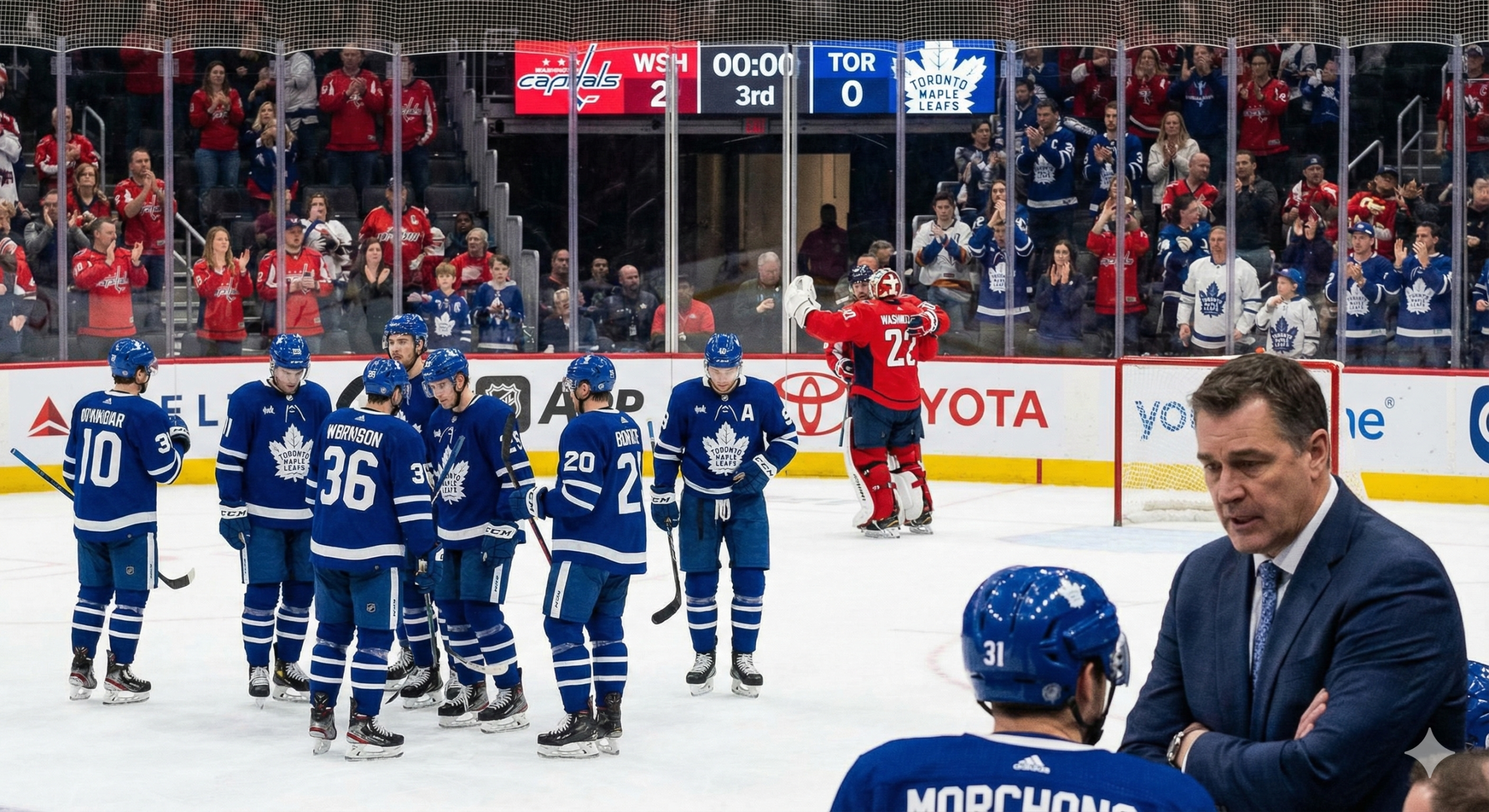
Not long ago, the Toronto Maple Leafs’ power play was regarded as one of the NHL’s most dangerous weapons. With elite scorers, quick puck movement, and confidence bordering on inevitability, opposing teams knew that even a minor infraction could tilt the game in Toronto’s favour.
Those days feel increasingly distant.
On Thursday night in Washington, the Leafs’ once-feared power play was again unable to deliver, playing a central role in a 4–0 shutout loss to the Capitals that exposed lingering problems with Toronto’s special teams, lineup balance, and offensive urgency. The defeat marked the Leafs’ first shutout loss of the season and underscored the growing frustration surrounding a team still searching for consistency nearly halfway through the campaign.
A Statement Move Behind the Bench
Head coach Craig Berube did not hide his dissatisfaction. Faced with five power-play opportunities — including three in the opening period — Berube made a rare and pointed decision: he reduced ice time for his top unit, sending stars Auston Matthews, William Nylander, John Tavares, Matthew Knies, and Morgan Rielly to the bench for extended stretches.
Instead, Berube leaned heavily on the second unit, signaling that reputation alone would no longer dictate deployment. It was a clear message: effort, execution, and effectiveness matter more than name recognition.
The move reflected a coach testing boundaries early in his tenure, and perhaps growing impatient with a power play that has struggled with zone entries, puck retrieval, and finishing chances.
Power Play Problems Run Deeper Than One Night
Toronto’s power-play struggles did not begin in Washington, nor can they be explained away as a bad night. The issues are structural and persistent.
The Leafs repeatedly failed to gain clean entries, often resorting to predictable drop passes that Washington anticipated with ease. Once set up, puck movement slowed, shooting lanes disappeared, and Toronto found itself battling along the boards rather than creating high-danger chances in the slot.
In contrast, the second unit — featuring Max Domi, Easton Cowan, Nicholas Roy, Bobby McMann, and defenceman Oliver Ekman-Larsson — showed flashes of urgency. While they did not score, their movement was crisper, their forecheck more aggressive, and their approach simpler. That contrast alone may force Berube to seriously consider a more balanced two-unit system going forward.
Dennis Hildeby Deserved Better
Lost amid the offensive frustration was a strong performance from Dennis Hildeby, who was one of the few Leafs to emerge with credit. Starting in place of Joseph Woll, Hildeby made 27 saves, keeping the game competitive far longer than the final score suggests.
The young goaltender entered the game among the NHL leaders in save percentage in limited action, and he showed poise against a Washington team that capitalized on Toronto’s defensive lapses rather than dominating territorially.
Hildeby was beaten first when Toronto lost key puck battles in front of the net, allowing Aliaksei Protas to open the scoring. Two more goals came off defensive breakdowns and slow line changes — the kind of mistakes that leave goaltenders exposed regardless of form.
Capitals Execute, Leafs Falter
Washington didn’t overwhelm Toronto with speed or volume; instead, the Capitals were efficient, opportunistic, and disciplined. They took advantage of Toronto’s mistakes and defended their own zone with structure.
Jakob Chychrun, one of the league’s most dangerous offensive defencemen, made Toronto pay twice — once on a rebound that caught the Leafs scrambling, and again after a slow change gave him a clear shooting lane. Veteran defenceman John Carlson capped the scoring, illustrating the difference between a team that capitalizes and one that hesitates.
Perhaps the most ironic note of the night: Toronto successfully kept Alex Ovechkin off the scoresheet. Hildeby denied him multiple times, and Ovechkin even rang a shot off the iron. Yet neutralizing one of the greatest goal scorers in NHL history mattered little when Toronto couldn’t generate offense of its own.
Line Juggling Fails to Ignite Offense
Berube also experimented at even strength, attempting to spark a struggling John Tavares, who has just one point in seven games and two goals in his past 15. Young forwards Easton Cowan and Nick Robertson were given opportunities alongside the veteran centre, injecting energy but not results.
Later, Berube shuffled again, placing Cowan with Matthews and Nylander in the third period. While the effort was there, the execution was not, reinforcing a troubling theme: the Leafs can rearrange pieces, but the spark remains elusive.
At the other end, Capitals goaltender Logan Thompson delivered a calm, efficient performance, stopping all 27 shots he faced. The shutout strengthened his case as a starter and highlighted how few truly dangerous chances Toronto generated.
The Bigger Picture in the Standings
The loss dropped Toronto to 15-13-5, pushing them further back in a tightly packed Eastern Conference wild-card race. While the season is far from lost, the margin for error is shrinking, and games like this — where opportunities are squandered — loom large come spring.
Toronto has now been shut out for the first time in 70 games, a statistic that speaks to the team’s offensive depth but also makes Thursday’s result more alarming. When a team built on scoring goes silent, alarms are justified.
A Test of Leadership and Identity
Perhaps the most important takeaway isn’t tactical but philosophical. Berube’s willingness to bench stars on the power play suggests he is trying to establish accountability and redefine the team’s identity.
The Leafs are at a crossroads: either recommit to hard, direct hockey that supports their skill, or continue relying on talent alone and hope it eventually clicks. The league has evolved, and opponents are no longer intimidated by Toronto’s reputation.
What Comes Next?
Toronto’s road trip continues, and the response will matter more than the result in Washington. Will the top power-play unit simplify its approach? Will Berube stick with a balanced special-teams setup? Will leaders like Matthews and Tavares respond with urgency?
The answers will define not just the next few games, but the direction of the season.
Leave a Reply